FIRST-TIME BUYER'S GUIDE
Say you've found a chamber that fits in your spare room. Will it fit around the turn in the hallway? Can you get in and out comfortably? And do you have somewhere to put the equipment that goes with it? These are easier questions to answer before you buy than on delivery day.
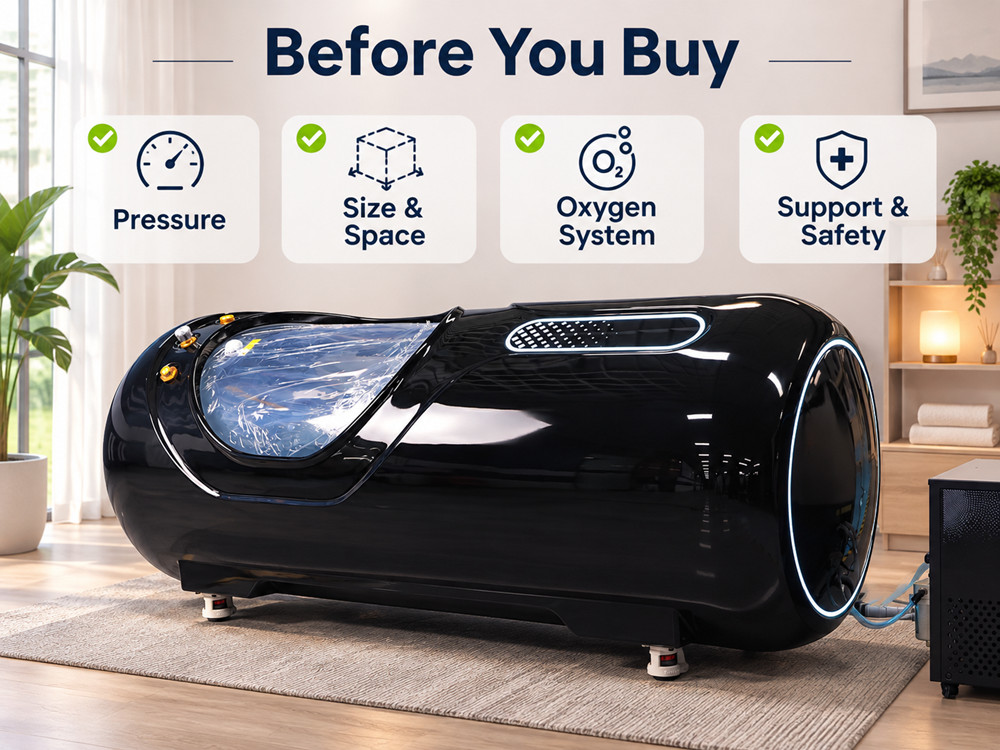
Find out whether the exact model is appropriate for your intended setting. Measure the room and the route to it. Then ask what setup, supervision, and upkeep the model requires.
A product page that says “home use” can't tell you whether the chamber is suitable for you or appropriate where you live. Check the instructions for the exact model and the guidance in your location before ordering. If you're considering hyperbaric oxygen therapy for a health condition, talk with a qualified healthcare professional first.
Guidance varies by country. For example, Australia's TGA advises consumers against buying a chamber for use at home.
Think about the movement involved. A sitting model may suit someone who finds it easier to sit down and stand up than to lower themselves into a lying position. But a high threshold or narrow opening can make a particular sitting model harder to enter. Ask to see an entry and exit demonstration for the model you're considering.
When comparing soft-shell and hard-shell models, look at how the opening works, how much space you have inside, and what setup and upkeep each model needs. Ask for the clear opening width and the seat or bed height. If you need help getting in or out, check how much room the person assisting you will have.
Start at the delivery point and walk the route to the room. Note the narrowest opening and the tightest turn. Ask for the shipping dimensions and the dimensions of the largest piece that needs to come inside. In the room, allow for the door or opening, the external equipment, and the space needed to service it.
If the route includes stairs or an elevator, flag that before ordering. Ask the supplier to review the measurements and confirm the model's power, ventilation, and clearance requirements.
Request a written list of what's included. Check for the compressor, oxygen equipment, mask, tubing, and any cooling or comfort accessories shown on the product page. In an air-pressurized model with mask oxygen delivery, air pressurizes the chamber while the mask delivers oxygen to the person inside.
Ask where the delivery team will leave the equipment, who will bring it into the room, and whether setup help is on-site or by video. If support is remote, ask what you'll need to do yourself and which tasks require a technician.
Ask for the manual before you pay. Look at the checks required before use, the cleaning instructions, and which parts need periodic replacement. Find out who you would contact if you noticed an unusual noise or an error message. If noise or heat is a concern in your room, ask for measurements or a demonstration for that specific setup.
An inside control panel tells you where the controls are. It doesn't establish that the chamber can be used alone. Follow the manufacturer's instructions for operation, supervision, and which items can go inside.
For your budget, add any room preparation, indoor placement, setup, and ongoing costs such as electricity, replacement items, and service. Ask who pays for parts, labor, and shipping if the equipment needs repair.
It depends on the opening, threshold, seat or bed height, and how you move. Compare the actual entry dimensions and ask to see how users get in and out.
Check your actual clear opening and the largest piece being moved. A hallway turn or stair landing can be the limiting factor even if the doorway is wide enough.
Access to the controls doesn't replace any required supervision. Confirm the model's instructions and make sure you can meet those requirements before buying.
Share your room dimensions, narrowest doorway, and access needs with HaoHealthy so we can help you compare configurations.
Ask About Fit and Setup